By Claudia Mumo
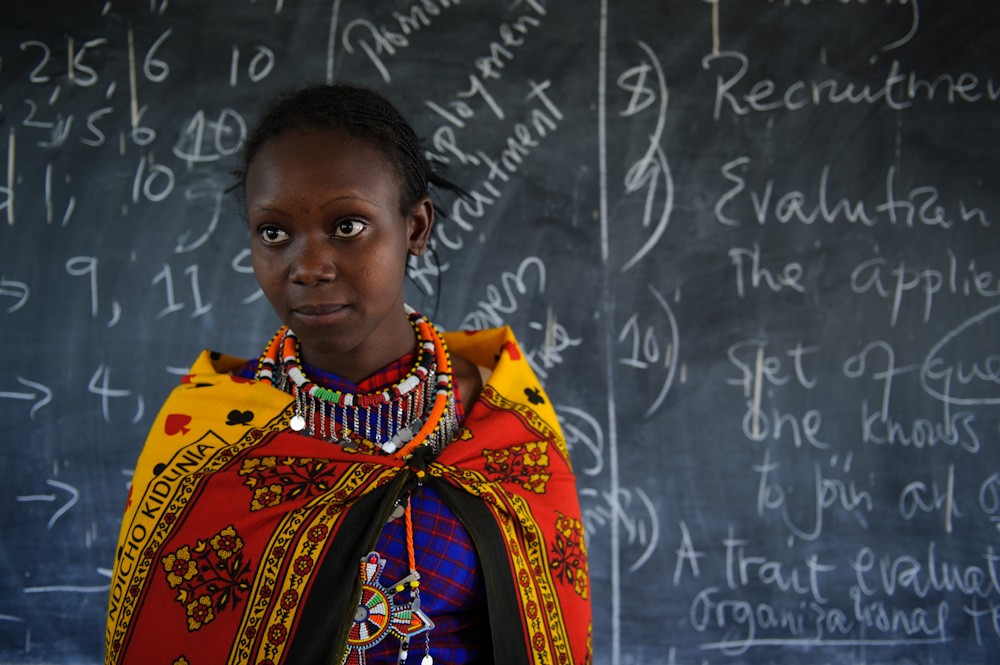
Standing by the roadside at 7 am at Kisaju, Kajiado County, one sees little more than dusty plains and a few buildings clustered together to make a tiny town. The sun is already heating up the dust, and a hat and sunscreen seem essential to anyone who walks under it. But in the distance are a few running children. They are dressed in chequered red and white shirts and red sweaters, hurrying to school which starts in half an hour
About three years ago, most of these children would have been at home looking after their families’ cattle and spending their days lying in Kisaju’s long dry tufts of grass. Today though, Wednesday, they are rushing to get to class before Mrs Saimi, their headmistress starts making her rounds.
“She is very strict about late comers,” one of the little kids says when I ask them why they don’t want to be tardy. “She will make us clean the compound if we are not in class before the bell rings.”
From the fear in the student’s eyes when she spoke about the punishment, one would be mistaken to expect a vast compound. But it is not. Kepiro Primary School is a few buildings clustered together in the corner of a little plot just outside of a little town.
Mrs Saimi is standing outside watching students stream into their classes. She has a bell in one hand and a cane in the other. She sees me and asks me to stand beside her. At half past seven she rings the bell and classes begin. She will deal with the late comers who will be sent to her office later.
“I never wanted to be a teacher,” she says as soon as we step into her office. “I never liked children that much. I didn’t even want any of my own.”
Judith Saimi is not a trained teacher. She is an administrator trained in management. She had grown up in a home with three wives and 13 children. “I had no space to myself,” she says with a reminiscent smile. “Everyone was everywhere. Just imagine four kids and one mom living in a tiny house without any bedrooms. Imagine the chaos.”
Everywhere there are many children together, there has to be some chaos. So why would she run a school even when she knew the kind of chaos having many children around brings? “Well, I think God insists we do some things even though we don’t want to. I wanted to work in a big office in Nairobi, not chase children around for homework,” she says. But it is a job that has to be done.
In a county where school dropout rates are up to 50 per cent, there needs to be someone who will chase the children and make sure they attend classes. Mrs Saimi is that person. “I woke up one day going to town and noticed that there were so many children looking after cows. What life would that lead them to? Were they going to look after cows forever?”
So she cut her journey to Nairobi town short, and walked to Kepiro Primary School and took a job as a teacher. She had no qualifications at the time, but the school was desperate. At the time, it had only three teachers; and students bored of having to share classrooms and have interactions with their instructor only once a day kept dropping out.
Mrs Saimi would have none of that. She sits back in her modest office chair and looks out of the window. “Those children deserve a brighter future than they think. If I have to talk to every single parent personally, to threaten and negotiate and convince them by hook or crook, I am not going to let those kids drop out.”
She isn’t joking. Mrs Saimi has knocked on doors and talked parents into bringing their children back to school. Sometimes she threatens the parents with the law. Sometimes, mostly for the girls, she argues that they will fetch a better dowry if they are educated. Whatever her methods, they have worked because for the past 5 years that she has been at Kepiro, the student population has grown from 300 to 450.
We are sitting in a tiny office with bare-minimum furnishing. The question was practically asking itself – how good is the pay? “It is enough,” is all Mrs Saimi is willing to say about that. Then with a smile she adds, “Barely. But it isn’t about my pay. I have a duty to these kids. Fulfilling it is my salary.”
One of the teachers, Mr Robert Karanja, has worked with Mrs Saimi since she started at Kepiro. “I’ve never seen her take a day off without good reason,” he says about her. “She works so hard for these children, and that inspires us to do our best as well.”
“Children benefit a lot more from passionate people than they do from strictly professional teachers,” claims Faith Mutheu, an early childhood development education trainer. She has trained teachers for more than 10 years. “Without a doubt, it’s the teachers who teach for the love of teaching that make the best adults. They pinpoint creativity, and direct children to a better way of thinking.”
Kepiro Primary doesn’t appear in the pages of newspapers when KCPE results are out. The performance is average at best. But Mrs Saimi is bringing hope to a few children who had nothing to look forward to but cows, early marriage and a life of struggle. She is trying, with the help of ten teachers, most of them part-time, to bring a difference to the children’s lives, to arm them with the knowledge and skills that most of us take for granted.
“There’s always something you can do to help,” she says as I shake her hand to leave. Judith Saimi is definitely doing her part.

 All things Lifestyle